On his first snorkeling trip last year, Aidan Garcia of Deerfield Beach felt like a fish out of water.
“It was super scary getting in the water for the first time because I couldn’t feel the bottom,” says the 15-year-old. “But the life jacket and the people on board gave me the reassurance that I needed that it was safe. I got to see a lot of cool things like active coral reefs that haven’t died yet, and a lot of marine life.”
Garcia’s snorkeling experience was part of Sea Lab, a free after-school program at the City of Deerfield Beach Teen Center that uses art to teach science and environmental conservation to students from Title I high schools, which receive additional resources to support economically disadvantaged students. The program is sponsored by the Rotary Club of Deerfield Beach.
Alexa Simeone, founder and executive director of Lele Art Lab, which includes the Sea Lab program, grew up in Miami Lakes. Although the ocean played a big part in her adolescence, she recognized that not everyone raised in South Florida can participate in ocean activities.


“I realized that a lot of the youth that I was seeing did not have access to these blue spaces and usually science and design after-school sessions are not accessible to many families. After-school programs and summer camps are not resources that every parent has to provide for their kids,” she says.
For Simeone, the ocean is a big unifier. She uses the program as a vehicle for kids to enjoy ocean exploration through art and science.
“It’s really important because sometimes science, the way it is presented, tends to sideline youth that probably don’t see themselves as scientists or youth that don’t see those media messages of themselves in the world of science.” Simeone, who is Colombian-American says: “As a first-generation American, I realized that if we can change the face of science and we have it reflect a greater community, then we have greater innovation. We have greater insights.”
Simeone views the mission of Sea Lab as “doing good through creative expression.”
“We unite the power of art with the practice of science to redefine how youth learn about the environment,” she says. “We want to solve the loss of science learning, make it less complex, more inclusive, and ever more engaging.”
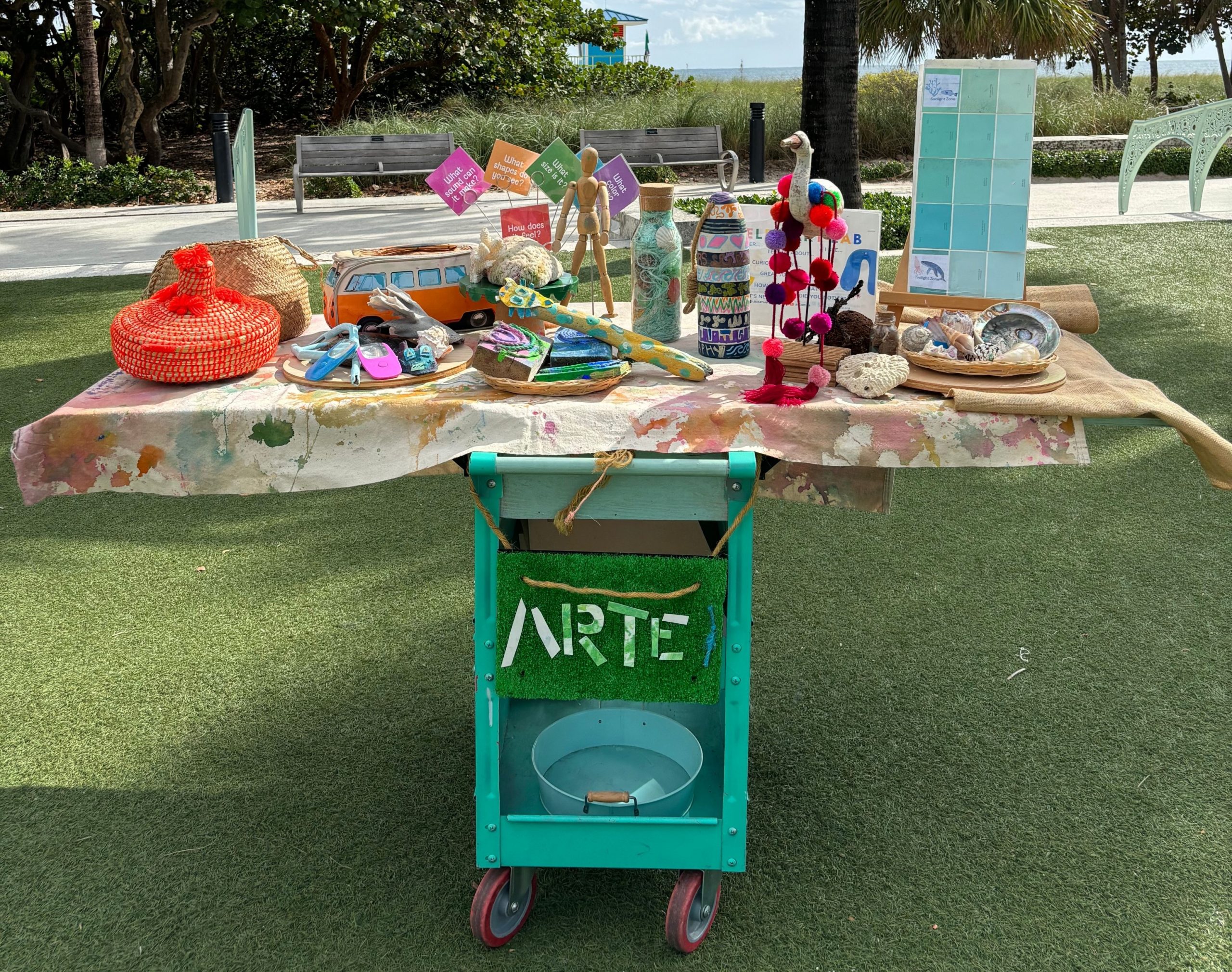
In the program, ocean trash becomes art and “maker labs” replace traditional science lessons.
“We unite the power of art with the practice of science to redefine how youth learn about the environment,” she says. “We want to solve the loss of science learning, make it less complex, more inclusive, and ever more engaging.” Alexa Simeone – Founder and executive director of Lele Art Lab, which includes the Sea Lab programAs part of World Oceans Day on Saturday, June 8, the students will present their capstone project, “Printed Oceans: A Quilted Narrative of Marine Debris” at the Sea Lab art show in Deerfield Beach. The art installation includes an ocean clean-up at 9 a.m., an open art class led by the Sea Lab students at 10 a.m., and an 11 a.m. presentation of their project.
“Printed Oceans” uses trash collected during ocean cleanups this spring and marine debris donated by local divers to construct the ocean-inspired quilt. Simeone says that the panels of the quilt, measuring 102 feet in length by 96 inches in width, are constructed from upcycled sailcloth and consist of colorful panels of prints made from collected ocean trash.
“It’s basically a sailboat that we’re making,” says Taylor Morgan. “The quilt is made from prints of ocean trash like bottle caps and broken shoes that we collected on our beach cleanups,” says the 16-year-old.
Past projects included building a child-sized playhouse, creating an ocean-friendly garden at the Teen Center, and utilizing seashells and driftwood in smaller take-home art projects.
“The teens have been little scientists. They’ve been engineers. They have built things like the playhouse. They have had to learn how to use tools. They had to learn how to follow instructions. They have been teachers where they have gone on location and taught little kids who attended the art show how to make art with the trash that they’ve got. So, they’ve learned a lot about a lot of different careers,” says Anthony Carter, Parks and Recreation Manager I at the Teen Center.
In addition to art and design, the 17-week program also focuses on field exploration, such as trips to the Marine Lab in Key Largo, snorkeling, paddle boarding, and slogging through the Everglades.
The Teen Center provides transportation, staff, and lifeguards.
Carter says that Sea Lab has been life-changing for the students.
“The experiences that they have had, they would most likely not have gotten them. They’ve gotten to go out on boats. The walking through the Everglades and sloshing, the kayaking, and snorkeling, those are experiences that I never had, and I got to experience with them,” says Carter.
This accessibility is important to Simeone, who champions that art, science, and environmental conservation be accessible and inclusive.
“I would say 99 percent of our students do not know how to swim so that’s also what this program brings together. It brings them a new science identity to realize that science can be done through the power of art, and it also exposes them to blue spaces that are often not accessible to the many kids that we serve,” says Simeone.
For Morgan, Sea Lab field trips have lifted marine science from the pages of a textbook—bringing sea life to life.
“I saw a barracuda and on a different trip, I saw a nurse shark. This was my favorite experience because I had never seen an actual shark before,” she says.
The program has also changed how students like Morgan feel about science.
“I wasn’t really interested in science before. I did want to learn more about the ocean, but I didn’t really have anything to teach more about it except for YouTube and stuff. Once I joined Sea Lab, it made me think about a future career in a path like marine biology,” she says.
For Garcia, the experience has not only broadened his ideas about art and science, but also made him more willing to try new things, he says. That first snorkeling trip with Sea Lab inspired him to continue to develop his swimming skills and, hopefully, attend scuba school in August.
“I had no experience swimming in open water before I joined the program and now, I’m not only interested in it, but doing it on my own,” says Garcia.
REGISTRATION
WHAT: “Printed Oceans,” Sea Lab Capstone Project for World Oceans Day
WHERE: 200 N.E. 21 Ave., north of the Deerfield Beach Pier, Deerfield Beach
WHEN: Saturday, June 8, 9 a.m. to noon
COST: Free
INFORMATION: Sea Lab Science