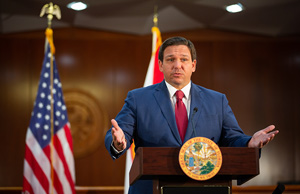

In an unprecedented move and only two weeks before the new fiscal year began for Broward County arts organizations, Florida Gov. Ron DeSantis vetoed more than $32 million in state arts grants, shocking leaders of arts and culture organizations.
The state arts grants would have supported 663 arts and culture organizations. All were denied. For Broward County, 54 grant requests with a total of $3.3 million in arts funding are not coming to groups in the County.
Line 3260A in the 16-page veto list wiped out $26 million in cultural and museum grants and 3266A slashed $6,047,838 million for cultural facilities.
“The governor has, in the past, zeroed out arts funding in his proposed budget but has never vetoed (all of the arts funding) in the budget presented to him by the legislature,” said Phillip Dunlap, director of the Broward Cultural Division, adding that state arts funding was severely cut in the wake of the Marjory Stoneman Douglas school shooting and back-to-back hurricanes to divert more funds to school safety and hurricane response.
“Even in that instance, it was the legislature that cut the budgets, not the governor through a veto,” said Dunlap.
[RELATED: See the complete veto list here.]
Arts Boosts Florida’s Economy
Facts back up that arts and culture are a major contributing industry to the state’s economy.

“There are statistics that show that the arts in every county in Florida get a financial boost of a 9 to 1 return,” said Dunlap. Using the 9 to 1 ($9 locally for every $1 spent) return on investment equation, that’s a loss of $30 million in Broward alone.
“The amount of arts funding (the governor) vetoed is de minimis to the billions in surplus Florida carries, but the local detriment is extraordinary. These programs are not only vital to fostering culture and creativity, but they’re also sound investment components to all communities,” said Sen. Jason Pizzo, (D-Hollywood). In Pizzo’s district, the Art and Culture Center/Hollywood would have received $61,100, 47 percent of a recommended $130,000.
Statistics from the United States Department of Commerce, Bureau of Economy Analysis (BEA) showed that arts and cultural economic activity accounted for $39 billion of Florida’s economy and 3.1 percent of Florida’s Gross Domestic Product or GDP.
“As a leader of arts organizations in Florida since 1985, I have witnessed and was part of the phenomenal growth of art and culture in Florida. Much of this growth was stimulated by grants from local governments and the state,” said Bonnie Clearwater, director and chief curator of NSU Art Museum Fort Lauderdale, who added that the elimination of state funding “was disappointing especially as our programs and budgets for 2024-25 are already in place.”
For Broward County theater company New City Players, the recommended amount for funding was $22,810. It was the theater’s first year in applying for state funding, according to Tim Davis, the producing artistic director. And while the little more than $10,000 they could have received from the state would have boosted wages, for instance, “it’s not money we’ve had before and were relying on, but yes it will have an effect. Davis said there is a larger issue in the lack of state support than funding and something more far reaching.”

Why are you cutting something that drives the economy and drives the overall, to use a business term, the overall brand of the state? We could be a true artistic mecca based on the density and diversity of our population . . .it’s like Miami is the future of the country. . . I think in terms of population that is true, but when things like this happen, it makes it impossible to be true when it’s not supported on the state level . . . of what we could be on a cultural and artistic level.”
Listed on the state’s Florida Division of Cultural Affairs website, statistics trumpet how the arts are an economic engine, citing a national study by Americans for the Arts. The division cited that: Florida’s arts and cultural industry generated $5.8 billion of economic activity, including $2.9 billion by nonprofit arts and culture organizations; that the economic activity supported 91,270 full-time jobs and generated $3.8 billion in resident household income, and that Florida’s arts and culture industry delivers $694.7 million in local, state, and federal government revenue.
Florida’s Funding Drop
Less than 10 years ago, Florida ranked third in the United States for arts funding. In 2019, it was 48 out of 50 states, and then in 2022, the state ranked 17th among states in terms of per capita funding to agencies supporting visual artists, dance troupes and small theaters, according to data from the National Assembly of State Arts Agencies. The FY25 budget puts Florida squarely at the bottom again with its zero funding.
In responding to a request from the governor’s office on the arts veto decision, Julia Friedland, the governor’s press secretary, wrote: “The governor reviews every bill and appropriation that comes across his desk and uses his authority under the Florida Constitution to make veto decisions that are in the best interest of the State of Florida.” Friedland also provided a link to the governor’s prepared budget veto letter.
Mark Ard, the director of external affairs for the Florida Department of State, responded in an email that “this year, the focus was on member projects. Governor DeSantis’ ‘Focus on Florida’s Future’ budget does not include funding for General Program Support; however . . . (the) budget does include nearly $30 million in legislative line items for arts and culture agencies and organizations, which includes $5.3 million in African-American Cultural Grants that support renovations and boost the development of new facilities at our state’s numerous African-American cultural and historical sites.”
The loss of $70,500 in state funding to the South Florida Symphony Orchestra will impact arts education and outreach to the community, according to Jacqueline Lorber, CEO and president, who said that “we have to find a way to make the show go on, right? So, we have to do fundraising to work toward that gap,” said Lorber.
Getting More Involved
Jennifer Jones, president and CEO of the Florida Cultural Alliance (FCA) said the wake-up call, so to speak, has her rethinking strategy regarding advocating for the arts.
Almost thinking out loud, she said, “we have to have access to the executive offices. We were dealing with senators and representatives mostly and nearly exclusively because that’s where the budget is built, and that veto is the last thing. We focus on building up the appropriation as much as we can so that when it goes to the last part, it’s a balanced budget. And we hope that we make it past the veto pen, and (the governor) signs off on it because it’s already balanced. But we have to look at ourselves and say, ‘Wow, we didn’t see that coming but why didn’t we see that coming because it was always possible?”
On the advocacy front, Dunlap believes that local arts groups should become more engaged – that the membership from Broward in the FCA is only about 20 and that the majority of organizations slated to get funding from the state are not members of the alliance. “Which means that they’re likely not engaged in the advocacy piece,” he said. For local arts groups, Dunlap believes that engagement is key. “We can’t only raise our voices when there’s a crisis, but we should be engaging those legislators and advocates in the conversation on a regular basis – and on the local level with our commissioners. If we’re more engaged on a regular basis, it may just make it a lot harder for these things to happen.”
Funding Florida’s arts community is a roller coaster ride and, as just proven, can be struck down by a politician’s whim. “It is a line item that is subject to the veto because that is the way it is structured,” said Jones, adding that all arts grants are funded with non-recurring funds. “I want to acknowledge how damaging this is to people’s expectations and plans and their programming, but we do have to look at what can we do to avoid this next year? How do we get ahead of it?”
There is no reversing the veto, but concerned citizens can reach out to the governor and legislators to have their voices heard. Find out who your legislators are, how to contact them and what to say here.
To contact the governor’s office, call (850) 717-9337. For the House, contact the Clerk’s Office at (850) 717-5400. For the Senate, contact President Senator Kathleen Passidomo’s office at (850) 487-5229.
– Email Gov. DeSantis here.
– Contact a Florida House Member.
– Contact a Florida Senator.