Of all the places that would be considered a mecca for Deadheads, Broward County is probably not the one that leaps to mind.
Though the so-named, tag-along fandom of the long-gone Grateful Dead and its offshoots have long eclipsed the tie-dyed counterculture of the 1960s, Deadhead epicenters would more likely be the band’s hometown San Francisco, or cities like Denver or Eugene, Ore. Or New York — where the Empire State Building beamed a beacon of tie-dyed colors after the news Saturday night that Bob Weir had died at age 78.

To call Weir the Dead’s founding rhythm guitarist and vocalist would be selling it short. His affiliation dates back to a jam session with lead guitarist Jerry Garcia a couple of years before the group evolved from a jug band into the Grateful Dead. That seminal session took place on New Year’s Eve, 1963. Weir was only 16.
But fast-forward now 60 years to one more New Year’s Eve. And that is when — as if conjured from the “long, strange trip” lyric of Weir’s most famous song — Broward County did indeed land at the epicenter of the Dead universe.
Playing then with a new band, Wolf Bros, and under his old nickname, Bobby Weir literally ushered in 2024 during the finale of three-show late-December run at Broward Center in Fort Lauderdale. New Year’s Eve shows and residencies were long-standing Dead traditions. But for Broward Center, it was an unprecedented and extraordinary coup.
And it turned out to be such a high time for the band, the fans and the venue that Bobby Weir & Wolf Bros featuring The Wolfpack eagerly returned the following year for a four-show residency that again climaxed on New Year’s Eve — and then kept on truckin’ into the first dates of last year with two, scaled-down performances at The Parker.
“Those two New Year’s Eve residencies had an amazing impact on us,” says Keith Hinson, the Broward Center marketing manager who oversaw promotion of the concerts. “Some of our shows have multi-day runs. But to have a titan of the music industry sit down for one, two, three, you know, six days as he did just last year, it’s something that doesn’t happen here often.”
“And that was really the first time it took place in that form and fashion. It was a yearly tradition we were hoping would continue.”

The tradition had rippled from a one-off show Weir played at the venue in February of 2023.
“It sold out instantly,” Hinson remembers. “And the band, the management, they all had such a positive experience that when they were looking for a venue for their New Year’s Eve shows, they were really keen to come back for a couple of days.”
While the South Florida winter weather was a draw, Hinson believes the band’s overall positive experience at the venue was what brought them back, as well as “seeing a large community here going out to see live shows.”
“I think there was trepidation about what our fan base looks like in South Florida. Is there a big Deadhead community there?
And they found out that there certainly is. And they came out in droves. I think it really surprised a lot of people here as to what community there was. And what a spread of age demographics. You saw people that might have seen the Grateful Dead at Woodstock bringing their children and their children’s children. You saw families coming out. It was a beautiful thing to see such a vibrant Deadhead community in South Florida.”
Hinson describes the events as a tourism coup as well.
“Grateful Dead fans travel far and wide for their shows. And we saw that a large percentage of that audience came to town from out of state, some from outside of the country. And they came back the second year saying: ‘This is the best. We just love this town. We love this venue. We love this event.’”
The shows were all sell-outs, but their impact wasn’t contained to the performing arts center.

“Broward Center was transformed,” Hinson says. “And that’s not just because of the arrival of the band. That’s because of the arrival of the fans and the community. The buses pulled into town — and boy, oh, boy, both years we saw that in great numbers. And I know that the community at-large felt that. They felt that in restaurant and bar sales. Hotels were booked up. You saw tie-dye all throughout town, walking down by the river, walking at the beach. There were impromptu drum circles after the shows. The Deadhead community really landed right at ground zero here at the Broward Center and in Fort Lauderdale. It was sort of the cherry on top to an already wonderfully varied, open and loving community.”
***
Hinson, 48, has been an avowed Deadhead since catching a concert by Weir with his band Ratdog in New Orleans a quarter-century ago.
“It was sort of my first Dead experience,” he says. “And I’ve been chasing that feeling ever since. I would like to say I helped shepherd some of our team members into understanding what the Grateful Dead was, what their musical approach was, and the approach of the community that are Grateful Dead fans. And many of them have now become Deadheads.”
As any Deadhead worth his hookah will tell you, “There’s nothing like a Grateful Dead show.” That phrase has also come to refer to Shakedown Street, the bizarre bazaar-like sideshow that accompanies Dead-centric dates.
“We never really activated that area along the river before,” Hinson says of the fan-based pop-up hosted on the Wendt Terrace outside the center. “That’s something that the band was really interested in us embracing and helping to organize. And there was a lot of trepidation at the venue because, again, a lot of people here weren’t quite sure what Shakedown Street was. ‘Are we inviting in a chaotic element?’ And having been to many Shakedown Streets over the years, I was able to explain that, no, this is a really positive place. This is really just a wonderful celebration of this music and of the art that followed this music.”
The patchouli-scented gatherings went off without a hitch, says Hinson, who coordinated the Shakedown Street experiences.
“They could not have been more successful. There were no issues with any of the guests. There were no complaints from the community. There were a lot of local residents just walking past the Broward Center, who didn’t have a ticket, happened upon Shakedown Street and found themselves immersed in that party.”
And when the Weir residency moved on to The Parker for the shows last Jan. 2 and 3, Shakedown Street moved with them.
“Interestingly enough,” Hinson says, “you go to a Phish show, you go to Widespread Panic show, you go to a Goose show, you name it, there’s a Shakedown Street there — and it’s not named after one of those bands’ songs. No, it’s still called Shakedown Street. It’s still an homage to the Dead.”
***
Weir’s late-career rebranding to his fan-familiar nickname of “Bobby” harkens to his early days with the Dead, back when he was considered “The Kid” of the group. It didn’t quite approximate the legendary Lennon and McCartney polarity, but the Garcia-Weir dynamic was still a balancing act, a contrapuntal synergy. Weir added an edgy intensity to Garcia’s laid-back virtuosity, his youthful, angular onstage persona bouncing off the frontman’s elliptical “Papa Bear” cool. Similarly, Weir’s often rigorous singing and strumming ran counterpoint to Garcia’s reedy tenor and effortless, bell-chime fretboard runs.
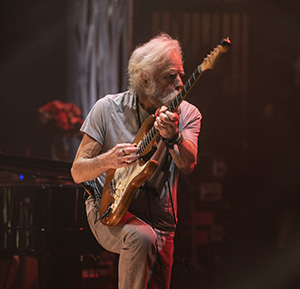
By the time Weir entered his mid-70s, he’d grown well-accustomed to standing alone in the spotlight. Sporting a white Yosemite Sam stache at his Broward Center shows, a rasp had sanded off a bit of that vocal edginess, but the vigor of his performance seemed only mildly diminished as he belted out lyrics echoed by the crowd and plunked out solo riffs on the marathon jams that had once been Garcia’s domain.

“I didn’t get to spend a lot of time around him during those residencies, but I did get to meet him,” says Hinson. “He spent most of his time on his tour bus, but we also had a backstage area set up for him where he would meditate. It was a very Zen area for him to center himself before he performed. Bob transformed over the years from the young crazy guy in the band to the sort of the sage, old, wise man. And I felt that he carried a lot of gravitas. There was a lot of deference to him, just so much respect and love. All the musicians, the crew, the management with his organization — they were all fans first. You could tell they were living out their dream, able to be a small part of the Grateful Dead world.”
That’s something to which Hinson can relate, with his 12 years in the industry as a programmer, producer and marketer, including the last two-and-a-half at Broward Center.
“I am a lot of who I am, as somebody that loves live events and works in that industry, because of the music and what I learned being a fan of the Dead. I look at the model that they set forth and how they broke a lot of rules and did things that no other bands did at the time. And they created a lane for themselves, you know, from allowing the taping of their shows to the improvisational style to the multi-nights in one city and not repeating a single song. Their approach is something I take with me in business and in my pursuit of art in my life.”
The professional Deadhead, as it were, actually even got to be part of the show.
“I’m an acrobatic stilt walker, and they were looking for a sort of carnival experience at the stroke of midnight. They threw out the idea of a stilt walker and I was like, ‘I know a guy.’ So I actually got to take part in the New Year’s Eve moment, which was something that I’m going to take with me forever — that I got to perform with Bob at his last New Year’s residency.
“He was everything I wanted him to be — a little quieter than I expected him to be, but very centered and just very wise. And so, yeah, this is a tough time. So there’s a new normal in my life, because I won’t be able to hear that voice again.
“But at the same time, I couldn’t be more grateful — to pin it on the nose there.”
This story was produced by Broward Arts Journalism Alliance (BAJA), an independent journalism program of the Broward County Cultural Division.