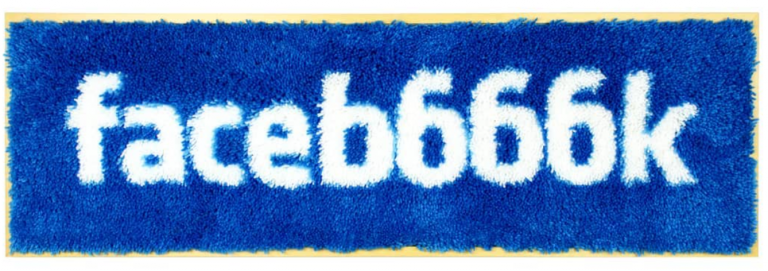
You may have heard the expression, “Brevity is the soul of discretion.”
Well, “Brevity is the soul of art” in the current exhibition at the Bailey Contemporary Arts Center (BaCA) in Pompano Beach.
At “SMS: Semantic Textiles Art Exhibition,” on display through Friday, Sept. 20, the show’s creator and curator, Lisa Rockford of Rockford Projects, has put together a very “of the moment” show that sprawls through three galleries and over 6,000 square feet, with 70 works by 20 artists. Rockford owns Rockford Projects, an independent curating business.
Those exhibiting focus on word art, with unusual approaches such as sewing, quilting, embroidery, knitting, weaving, rug-hooking, and basketry.
Word art refers to items that convey strong messages via language rather than images. Word art often has a more direct impact than more subtle forms of art because it is read rather than viewed and analyzed, according to Adam von Dolle, one of the artists exhibiting at BaCA.
“Word art has been around for several decades, but it has crossed over into the fiber art and ‘craftivism,’ movements. Fiber art is being used to communicate, such as protest signs and banners,” says Rockford.
According to Rockford, fiber art was considered handicraft or known as women’s work before the 1970s.
“Now it’s a collectors’ item. These traditional materials and techniques get new spins,” says Rockford.
Historically, Persian rugs, medieval tapestries and Australian aboriginal art (now printed on fabric) were culturally significant and told important stories.
There is a long history of women crafting their own messages in pursuit of higher aims. Since the late 1800s, suffragettes marched in front of the White House with vertical banners they had sewn demanding a voice in government.
Thousands wore pink knit or crocheted “pussy hats” at the Women’s March in Washington in 2017, just after President Donald Trump’s inauguration. In Great Britain, women smuggled fabric scrolls on bamboo sticks into the Ladies Gallery of Parliament. American chapters of the Anti-Slavery Sewing Society made clothing for runaway slaves.
In America’s colonial era, George Washington commissioned Betsy Ross to sew the new United States of America flag, which in itself was a powerful symbol to unite the 13 colonies into a nation, in protest of King George ruling from the United Kingdom.
Now, text messaging, which has become part of our daily lives, has given opportunity for new expression, says Rockford.
Because texts are everywhere, “written language has transformed into something increasingly abbreviated and fleeting. Words have replaced imagery as a central focus,” Rockford says.
The exhibition at BaCA gets its name from SMS, which stands for “short message service,” the original name for texting.
The “SMS” exhibit is organized around three themes. The west gallery assesses violence, control and resistance; the center ironically elevates stereotypes, slurs and vulnerability. The east gallery shows the power and influence of social media networks.
Some displays, such as vertical banners, harken to the suffragettes, who marched for women’s right to vote. But the banners in the exhibit, “…have typical trolling messages on them, such as, ‘She should smile,’ and ‘She talks too much,’” says Rockford.
Such vitriol was directed at artist Natalie Baxter and went viral. Baxter says, “An article on (conservative political commentator) Glenn Beck’s website mostly criticized my “Warm Gun” series, (a collection of stuffed fabric guns.) But the comment section was where the real aggression lived — questioning my gender, sexuality, intelligence, and sanity. I turned these online comments into banners similar to those suffragists had sewn a hundred or so years back fighting for gender equality.”
Baxter has more than 12,000 followers on Instagram. But Rockford says that she doesn’t select artists based on popularity or how well-known they might be.
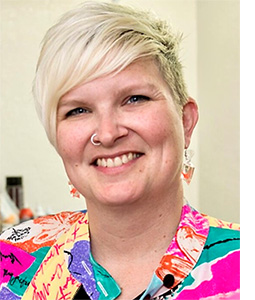
“It doesn’t matter to me if the artist is known or not. I like to mix emerging artists with those with more established careers. Emerging can mean not being seen by the right person. I can show artists with equal amount of talent and skill, but no matter how known the artist is; sometimes it takes luck and connections to get representation,” says Rockford.
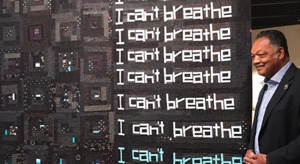
Everything in the show is for sale, except for the “The One for Eric G,” a quilt by Chawne Kimber, which is on loan from the MSU Museum at Michigan State University. In 2017, the work was included in the museum’s traveling “Quilts and Human Rights” exhibit, which made a stop at Northern Illinois University, where Rev. Jesse Jackson spoke to students. The two-day event also offered a Social Justice Sewing Academy where students were taught to make quilts with messages.
Kimber was inspired by the last words of Eric Garner, a Black man killed by a police officer in 2014 after being put in a chokehold. Other quilts say, “I miss hope” and “Watch your back.” She made the first quilt before Black Lives Matter, according to Rockford.
“‘I miss hope,’ could be interpreted as how people are happy in the current moment because of Kamala Harris running for president and hope is in politics again,” comments Rockford.
A Pompano Beach resident raised in Boynton Beach and Lake Worth Beach, Rockford is a tenured associate professor of Fine Arts at Broward College. She first began curating when she lived at the Sailboat Bend Artist Lofts in Fort Lauderdale.
“I saw a lot of gallery space that was not being used and began organizing exhibits. Curating is one of my great loves,” says Rockford. Since then, she has worked with 400 regional and national artists and curated 30 exhibitions.
Rockford gets ideas for a show by seeing trends on Instagram and Pinterest, by artists who have never met. “I see parallels and as a curator I draw them together.”
And she scouts talent at Art Basel Miami and elsewhere. At Art Palm Beach, she discovered an Argentinian artist represented by Isabel Tassara, founder of Coral Contemporary Gallery in Miami.
“I was in my booth when Lisa came over. I had never met her before. She wanted to showcase Ana Clara Soler’s work at the SMS exhibit,” says Tassara.
Soler creates textiles and watercolor on paper that are very expressive and creative, says Tassara. “Some of them can be used. One piece can be hung on a wall with an open cross in the middle. Poke your head through and use it as a poncho.”
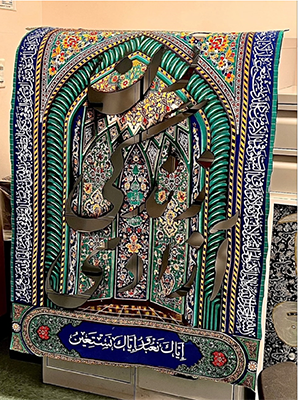
Another of Rockford’s discoveries adopted the pseudonym “TES.” She’s an Iranian woman living in Broward County. She won’t reveal her real name for her own safety and of her relatives who still live in Iran.
“I am now free to do many things I’ve wanted to do for 10 years and no longer self-censor. It’s liberating. Because once I execute my ideas, they are considered provocative and there is no going back,” says TES.
In the exhibit, her fabric hanging shows an arch facing Mecca and the Arabic message is, “Can’t set fire to women made of flames.”
TES bought the fabric, she says, while visiting Tehran. “I had no idea what to do with it until the Women, Life, Freedom movement came around. It ignited me.”
Von Dolle says he turned to art as he made a major life transition from corporate and society interior designer to philanthropist and full-time artist. He recently retired after 50 years as a decorator.
“My career was very fancy but not for me,” says von Dolle, who says he spent 35 years in New York City as a designer before coming to Broward. “I was designing rooms that looked like the Jayne Wrightsman suite at the Met. But it’s not where I want to put my energy at this time.”
The late Wrightsman was a Fifth Avenue socialite who helped redecorate the Kennedy White House and was a prominent arts patron married to an Oklahoma oil baron.
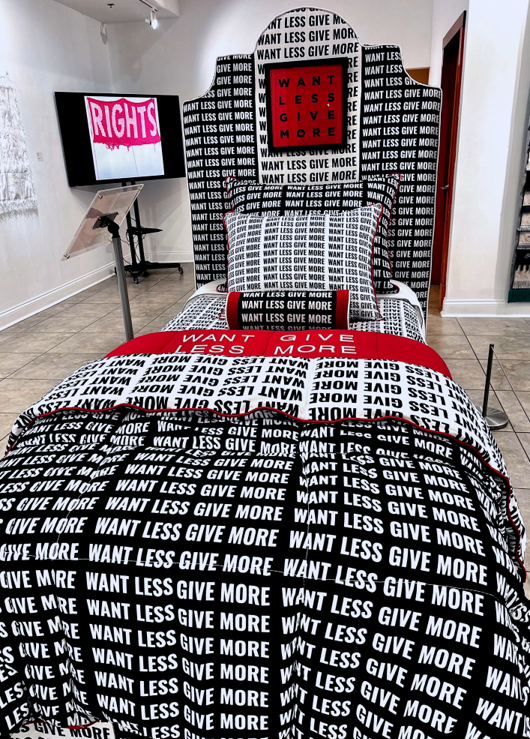
“Art is about extremes. Art should make people think and talk,” says von Dolle. “Most people look at things and if it’s not clear they move on, at 10 seconds at the most. My works engage people and saturate them with the message of that idea. Hit them immediately or they walk away.”
Von Dolle fabricated a twin-sized bed and a comfy chair in the style of a Bloomingdale’s display for the “SMS” exhibition with the message, “Want less. Give more.”
Von Dolle’s other passion is philanthropy. In 2019, he sold his five-bedroom, five bathroom duplex with a pool and a two minute walk from the beach in Lauderdale by the Sea to fund his own nonprofit, Pionero Philanthropy, in Guatemala.
Von Dolle’s hero is philanthropist Agnes Gund, a Park Avenue matron who chairs the Museum of Modern Art in New York; who sold her treasured Roy Lichtenstein painting for $165 million and spent the money rectifying criminal justice and racism.
He has “Aggie” tattooed on his arm.
It’s the ultimate SMS.
IF YOU GO
WHAT: “SMS: Semantic Textiles Art Exhibition”
WHERE: Bailey Contemporary Arts (BaCA), 41 NE 1st Street, Pompano Beach
WHEN: On view through Friday, Sept. 20. Closing reception is 1-3 p.m., Saturday, Sept. 21.
TICKETS: Free
INFORMATION: Call (954) 786-7870 or
http://www.pompanobeacharts.org