The conventions are over, and election season is about to shift into overdrive. On Tuesday, Nov. 5, Vice President Kamala Harris will face former President Donald Trump as they both attempt to claim the Oval Office. Between now and then, plenty of vitriol is likely to be spilled from both sides of the campaign trail, and from commentators across the news and social media.
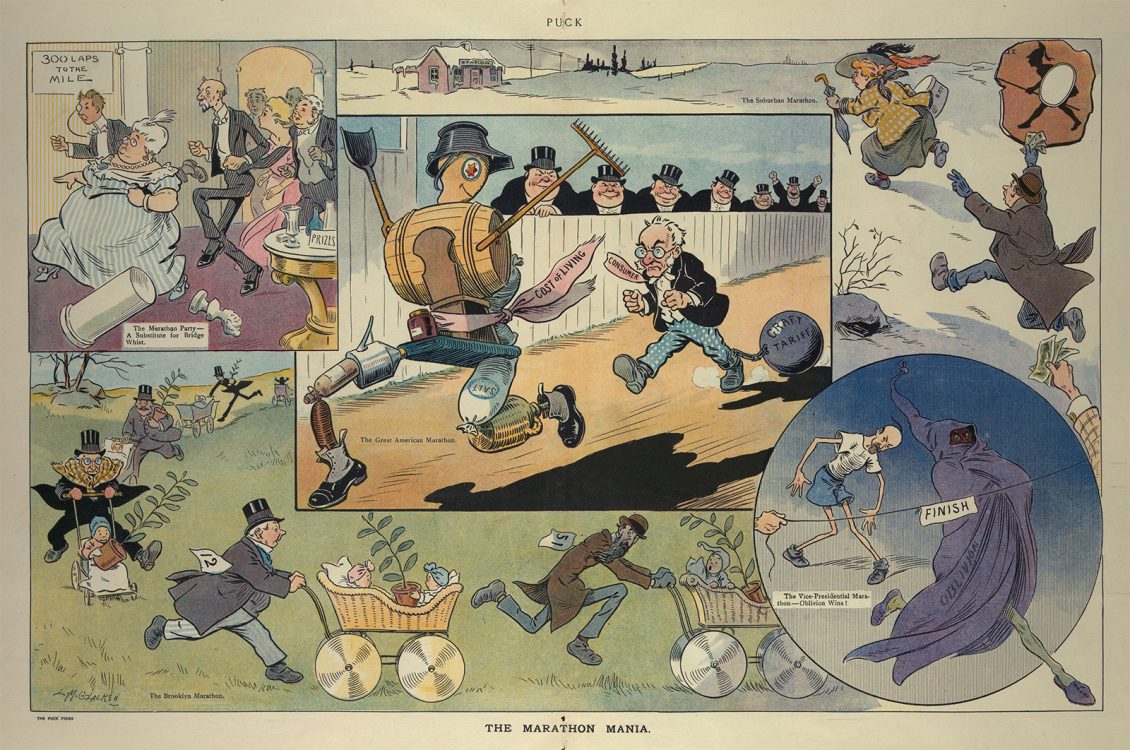
It can be exhausting, but as an exhibit at the NSU Art Museum Fort Lauderdale reminds us, it’s been like this for a while. “Louis M. Glackens: Pure Imagination,” which runs at the museum through March 2025, explores the inventive work of the early 20th-century illustrator and animator. He was the brother of William Glackens, a painter associated with the Ashcan School that specialized in realistic scenes of urban American life, for whom the NSU Museum has dedicated the wing in which the show is taking place.
While William made a name for himself painting impressionist-influenced street scenes, Louis was most famous for drawing political cartoons for the satire magazine Puck. Taking its inspiration and motto (“What fools these mortals be”) from Shakespeare’s A Midsummer Night’s Dream, the publication skewered the political culture of the day and influenced future humorists according to curator Arielle Wolens.
“It was really a political satire magazine that made the genre and really set the tone for a lot of political humor that’s still used in television and news publications, even things like (the HBO TV drama) Succession or (Last Week Tonight With) John Oliver,” says Wolens. . “It made these sort of equal-opportunist jabs at not just politicians but also business owners, trends in the middle class, and really an overall spectrum of looking at public behavior.”
While turn-of-the-20th-century politics may seem a bit obscure now – the UK-raised curator admits she had “a lot of history lessons” to catch up on – the period chronicled by the show bears many similarities to the present moment. Just like today’s billionaires, the ultra-wealthy held enormous sway in politics, and a reaction was building through the Progressive movement, spearheaded by President Theodore Roosevelt, and the labor movement, which was despised by Democrats and Republicans alike. Roosevelt and William Howard Taft, his successor and later rival for the presidency, engaged in trust-busting and increased regulations on businesses.
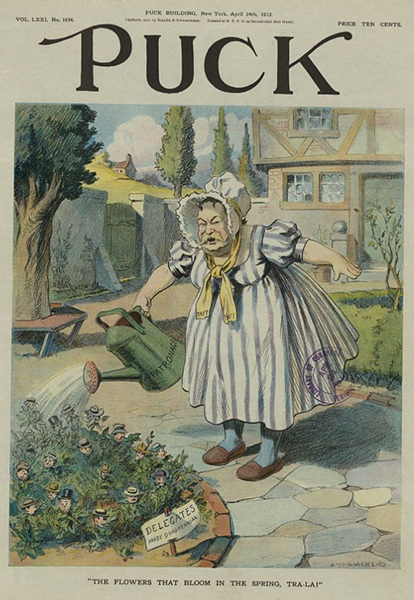
For Glackens and Puck, Roosevelt often didn’t go far enough – he was a staunch proponent of free trade and often helped to stifle organized labor. Their cartoons often directly addressed the government corruption that was endemic at the time. One on display serves as a great example of their particular voice, showing George Washington, clutching a potted apple tree, cringing at a congressional notice board showing agencies under investigation. The caption reads “This is no place for a man who couldn’t tell a lie!”
“I think (this work) is always timely just because, especially within the last 10 years, the news cycle has had such incredible intensity and volatility,” says Wolens.. “So I think it remains relevant. But of course, this is an especially heightened time, and it’s interesting, because the duality of the parties and the pitting against each other, I think that it’s more polarized than ever. You can see that (in the show) within the way that they deal with the nature of the relationship between Roosevelt and Taft, how the latter is sort of a protege becoming the opposition.”
Conflict abroad was also becoming an issue, with imperial powers in Europe and East Asia jostling for control of colonial territories – Glackens would address this in one Puck cover from 1909 titled “No Limit,” featuring personifications of all the great powers (including Uncle Sam). gathered around a poker table, betting on naval stockpiles. The tangled alliances between these great powers would eventually explode into World War I, and Puck would prove to be a casualty. Their solidly leftist political perspective earned the magazine few fans among the upper class, and their demise came from an all-too-familiar foe to even today’s independent media: A corporate takeover. The magazine was bought out in 1916 by newspaper baron William Randolph Hearst (the megalomaniacal model for the film “Citizen Kane”) who took out the political content. Puck shut down in 1918.
The show holds interest for those not too excited by century-old political cartoons as well. The artist took on plenty of side work, including creating packaging art for a company that made toy amusements like the Joy Buzzer. And Glackens’ artistic skill is obvious. “Even without knowing the exact historical context, I think it’s still accessible in terms of the strength of his work as an illustrator,” says Wolens.. “It’s very open, it’s very clear. It lends itself well to telling a story, and you can still see the humor in it, even though I can imagine it would sort of hit twice as hard if you were aware of the political intricacies of the time.”
Speaking of, fans of early animation will be interested in Glackens’ early animated short films, which were produced for pre-cinematic amusement venues like nickelodeons. Although most of them have been lost, one depicting a dinosaur was sent to be restored by specialists at the George Eastman Museum in New York. Unlike other early animators who focused on comedic characters, Glackens experimented with educational shorts about topics like evolution, as well as fantasy stories. This kind of work put him ahead of his peers, but it didn’t help him secure work.
“(His animation) wasn’t received favorably by the producers of the time, so he did about 10 or 15 titles, but then it didn’t really evolve into anything greater. But he definitely was one of the first, and I think that is definitely a history which provides a lot of connections that I haven’t seen made before, from this transition from illustration into feature-length cartoon.”
Political cartoons have faded in prominence since Glackens’ day. Today most political satire is done on social media through user-generated memes, although some artists such as Eli Valley and “The Onion’s” Stan Kelly continue to push boundaries with the form. The faces of politicians may change, but as Glackens’ work shows, incisive satire never goes out of style.
IF YOU GO
WHAT: “Louis M. Glackens: Pure Imagination”
WHERE: NSU Art Museum Fort Lauderdale, 1 E Last Olas Blvd, Fort Lauderdale
WHEN: 11 a.m. to 5 p.m. Tuesday through Saturday; noon to 5 p.m. Sunday; closed Monday. Thorough March 30, 2025.
TICKETS: $16 for adults; $10 for seniors; $8 for military, $5 for students 13-17 and non-NSU college students with valid ID; free for members, NSU students, faculty, and staff, and children 12 and under; free for all on the first Thursday of every month.
INFORMATION: Call 954-525-5000 or http://www.nsuartmuseum.org/